I am working on a new book dedicated to color theory for the glass beadmaker. This will likely be a lot longer than any of my other tutorials - I have lots of great information to put into this book. It's in the early stages, so it doesn't have a title, price or cover art quite yet. I just wanted to let everyone know that it is in the works and will hopefully be available at the beginning of the new year.
I do know that the ebook will be geared towards the beginning/novice beadmaker, but will have some information even for the intermediates as well. The book will focus on color theory, application and technical aspects of color, and will have some great color combination recipes and lots of pictures. I'm throwing in pretty much everything I know about the subject - so I hope people will find it useful, inspiring and most of all, fun! I'll keep you updated!
Tuesday, December 20, 2011
Technical Difficulties
Hi everyone -
Seems I am having some issues with my web host - this is why the pics aren't showing up. I am working on it - hopefully everythign will be back to normal soon! :)
**Looks like we are back up - yey! :)
Seems I am having some issues with my web host - this is why the pics aren't showing up. I am working on it - hopefully everythign will be back to normal soon! :)
**Looks like we are back up - yey! :)

Saturday, December 17, 2011
Cim Glass Testing: 803 Twilight Ltd. Run & 602 Purple Haze Ltd. Run
 I noticed yesterday that CiM has so many new colors lately, that I am way behind in testing! I am going to try and make up for it this year - it's one of my New Year's resolutions.
Today, I am writing about two newer colors - Twilight and Purple Haze. Both of these colors are limited run, so if you like them, get them as soon as you can.
 First up is Twilight, a gorgeous neutral transparent grey. This color fills a small hole in the 104 palette - it's not as warm/green as Effetre Slate Gray, and is darker and cooler than regular Effetre Grey. I like my greys to be on the cooler side, and this fits the bill nicely.
Twilight works up well - it's slightly stiff, but not enough to be a problem. It doesn't bubble or scum much - which is nice for a medium transparent color.
 It layers really well, too - here with Effetre Dark Grey. I really love the encased stringer it makes - it's a perfect nuetral shade.
  It also worked nicely as a layer between the opaque grey and the clear when encasing a base bead - it doesn't lighten too much. It is kind of stiff, so when using on top of a really soft opaque, like white or grey, make sure you use the outer part of the flame to heat it, to prevent the opaque color from melting faster than the Twilight. This will prevent any bleeding from the opaque underneath the encasing.
I saw no odd reactions in this glass when used with normal colors, and it didn't react with the clear I used - DH Aether. Twilight is a stable, consistent transparent color. Yey!

Purple Haze is also....well, not purple. CiM describes it as a lavender/blue color shift (a similar, more accurate description was given to CiM's Count Von Count). I found Purple Haze to be a lot less lavender/blue than Count Von Count. I think it sits comfortably between Count Von Count and Effetre's (also mis-named) Lavender Blue. What these people are thinking when looking at these colors is sometimes beyond me, in an amusing way. Thankfully, the name's not really that important, once you get to know the glass.
 |
| left-to-right: Count Von Count, Purple Haze, CiM Pink Champagne, Effetre Lavender Blue |
Purple Haze also doesn't color shift nearly as much in sun or fluorescent light as other lavenders do. It does a small amount - turning a light lavender color with pink undertones. In incandescent light, it is cool pink with lavender undertones.
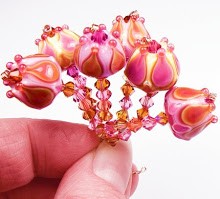
 In my opinion, we have quite a few lavender choices for both layering and encasing. So I decided to use this pretty pinkish lavender to brighten my pinks instead. Here, I layered it with Reichenbach's gorgeous Opal Raspberry, a warm, deep opal pink glass that I just love (and reviewed several years ago). It's the most saturated pink in the 104 line - and I wish it wasn't an opal! I hope CiM can make this as a dense opaque color some day.
Anyway, Purple Haze changed the warm pink into a cool pink - something which I just adore.
The major note with this color is to make sure you work it cool - too hot and it burns and you get scum. This is particularly true when using it as stringer. However, it does encase well, works as a layering color, and makes lovely spacers. It's a consistent color - no striking or odd reactions that I can see.
I plan to put this pale transparent over pretty much anything orange, pink or purple. It's also a limited run, so get it while you can. Nice job, as usual, CiM!


Monday, December 12, 2011
CiM Glass Testing: 504 Blue Suede Shoes Ltd. Run


The second thing you should know is that my camera hates it. More about that later.
I'll get right into the nitty gritty - this color was not fun for me. It's really pretty, but did not behave the way I wanted it to. Part of it is my fault - I wasn't aware it was an opal when I started working with it, and it was hard to tell at first. It only acts like an opal when you layer it - but not when you encase it. At least in my experience.

 |
| Blue Suede Shoes, paired with Effetre White, DH Aether and DH Ox. |
The glass itself does have a nice consistency - especially when compared with other opals. It's not stiff at all - it melts easily.
Blue Suede Shoes does tend to bleed just a bit from underneath an encasing. But it's not too bad - easily overcome if you take the time to move your encasing near the hole.

All in all, this is a pretty color, if you can get it to behave, don't mind a little bit of inconsistency in color, and if you like opals in general. It's not cobalt, though, in my opinion. It's closest to lapis blue.

Subscribe to:
Posts (Atom)





 Posts
Posts