Thursday, August 18, 2011

CiM Glass Testing: 632 Thai Orchid, 482 Mojito, 403 Army Men Ltd. Run

For me, the end of summer/start of fall means combining deep purples and lush greens. Yum!  This time, I started with one of the newest CiM colors - Army Men - and layered it with Mojito. I then combined the lovely result with one of CiM's older colors - Thai Orchid. Later, I added shades of amber to the mix for a really pretty autumn combination.

CiM Army Men, one of the latest colors in the CiM palette, is a subtle, muted pine green.  It falls somewhere on the bluer end of olive, with a lot of grey in it.  When I saw this color for the first time, I was reminded of the new version of CiM Commando.  In fact, Army Men sits right between Commando and Olive in tonality.  Olive has a bit more yellow.

I love the consistency of the glass - it was a dream to melt!  It is slightly soupier than some opaques.

Army Men is a dense color, despite its subtle shade, and can be layered and encased without washing out.  As many greens do, this color can bleed under encasing, and can take over other color just a little bit.  It's not as bad as some Effetre greens, but it is something to watch out for when melting in your decoration.

Army Men is also one of those colors that tends to streak and separate, which can either add variety visually, or be a pain in the a**, depending on your application. I found this only slightly irritating - for the most part, this glass behaved well and did what I wanted.

Alone, Army Men is kind of a "behind the scenes" color - one that works well as a background or filler in your designs. It made lovely spacers! This color really shined when I layered it with Mojito, which I will talk about next.


CiM Mojito is a wonderful companion to Army Men, and a lovely color in and of itself.  I've been remiss in waiting so long to review it here for you!  In pictures, this pretty pale olive green can sometimes look like just a plain yellow-green shade.  I personally think you need to see this one in person to appreciate the subtle, muted olive that it represents. It's slightly grey with only a bit of a yellow undertone. A great layering glass - with any green you want to lighten up and make a bit more subtle. It's the perfect fall green.

As a transparent glass, Mojito is smooth and not too stiff.  It didn't bubble or scum for me, nor did it react with anything at all.  It's very consistent and has a nice clarity to it.  I used it with Army Green for encased stringer, and it was very light and soft. If you want to go darker, stick some Slytherin in there!


Next we have a color that came out really early on, when CiM first started - Thai Orchid.
When it comes to opaque purple, CiM has at least half a dozen that are all really similar at first glance. They are all kind of reminiscent of Effetre's Violet shades.  They all have a slightly different way of acting, which is at the same time frustrating and fun.

Thai Orchid is at the dark end of the purple spectrum - a deep, dense violet purple. It shares some of the same characteristics as Effetre Dark Violet, but is more saturated and a little less reactive, depending on the batch you get.

I had two different batches of Thai Orchid - one that was significantly bluer than the other.  Both are lovely, though. You can see the difference in the spacers here.

As an opaque glass, Thai Orchid acts like most other opaque violets - it's streaky in the extreme, tends to spread out and bleed a little, and can pit or silver when exposed to different flame environment.  It does layer very nicely, though.  Without a layer of encasing, the lighter batch of this color doesn't do much for me.  Like most other violets, the shade is just too browned out.  But layer it with a transparent light purple or even clear and the brownish hue magically disappears, and you're left with a velvety deep violet.

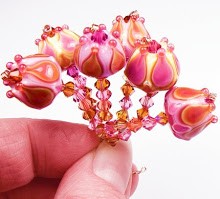
In my Autumn Song beads, I layered both batches of Thai Orchid with the now discontinued CiM Count Von Count (you can get a similar effect with Effetre 081 Dark Lavender), for a lighter but slightly more saturated purple.  Wonderful for fall, I think.

Have fun playing!  :)

Saturday, August 13, 2011

For my Facebook Friends and Fans

To everyone on my friends at Facebook -

I will be doing an overhaul on my Facebook account.  Since I have finally entered the 21st century and gotten an actual smartphone, I am editing my contacts and linking my accounts.

This means I need to separate my business contacts from my personal ones.

What I will be doing is inviting all of my current friends to "Like" my Artist page, and then unfriending all of the people that I don't personally know.  That way I still get to keep in contact with all my wonderful customers and visitors over on my "Kandice Seeber" and "Coloraddiction" Fan Pages, and keeping my personal profile for my family and friends and people I have contact with regularly.

This is mostly because linking my facebook account to my smartphone put all of my thousands of facebook friends into my mobile phone contact list, and this is just too confusing for my old brain.  :)  Separating the accounts makes more sense.

I love you all, and I wanted you to know that I am not unfriending you for any other reason than that I need my business and personal contacts to stay separate.  If you find yourself unfriended and you don't think that's right, please do feel free to re-friend me with a message.

Here are my fan pages -
Kandice Seeber
Coloraddiction

((((hugs))))
Kandice

Friday, August 5, 2011

CiM Glass Testing: A Bunch of Opals

I spent this week with some newer colors (new to me anyway) .....with some interesting, fun and somewhat frustrating results.

I decided to do all 4 of these colors in one post - mostly because all four of them make kind of a tiny spectrum of aquas and teals that all look good together. Also, they all acted very similarly in the flame and in front of the camera.

I'll go through them one by one, and then do some comparisons. One thing to keep in mind as you look at the pics (and this is the frustrating part)....all of these colors were very, very hard to photograph.  They tend to look a bit washed out and dirty in most pictures...which I suspect has something to do with the translucency.  Looking at the colors on the CiM website, I see I am not alone on this issue. In real life, all four of these colors are more saturated than can be shown here.

The first is 547 Electric Avenue - a color that has been around since pretty much the beginning of CiM.  It's classified as an Opal, which means it has a translucent, almost glowing quality.  CiM Opals can be compared to Effetre Opalinos and Alabasters - but in looks only.

In my experience, CiM's Opals are much less shocky and picky than their Effetre counterparts, and more compatible, thank goodness!  Electric Avenue in particular was really easy to work with.  It maintained its translucency for the most part, and seems to be compatible with clear and black as well as the opaque Effetre Light Turquoise I layered it with.

By itself, in spacers, Electric Avenue is a vivid, opalescent aqua shade, which is slightly lighter than it is in rod form. It tended to go more opaque when worked longer.

I played with the functionality of all 4 Opals, sometimes using them as an opaque base, and sometimes using them in place of a transparent, in layering.  

Electric Avenue encased well as a base with clear, and turned a bit opaque.  As plain stringer, it stayed opalescent. When used as an opaque flower petal base, it went slightly opaque, but you can almost still see the black bead underneath.  However, when layered on top of Effetre Light Turquoise, as seen here in the left floral, and underneath a dot of clear, it went a nice transparent light aqua.  Interesting!  I liked this color - easy to work with, not a lot of bubbling or burning, a nice soft consistency and a lovely color.  Now if I can just get the song out of my head!

Next we have 598 Atlantis, a teal blue Opal that reminds me a little of the color Mermaid.  Atlantis is very similar to Electric Avenue in consistency and workability.

As spacers, this color tended to vary in opacity a lot more - it was hard to actually make two alike!  There is some streaking in some of the more opaque spots.

One major difference between the two colors is that Atlantis seems to be a bit more sensitive to temperature.  It was the only color to crack under a layer of encasing - but only on one of the beads I made this week. The crack along the hole is thermal, which means that it most likely got too cold as I worked it.  It seems that the longer this color is worked, the more opaque it gets, so keep an eye on that heat if the color solidifies!

I tried the floral experiment on Atlantis, as I did on Electric Avenue above, with similar results. The flower on the right appears very translucent because there is no layer of opaque Light Turquoise.  I think it's a really pretty effect.  Atlantis stayed dark when layering, but still acted like a transparent when I needed it to, as on the left floral here, sandwiched between the Light turquoise and the clear.


Moving on, we have 499 Rainforest, a teal green opal. Again, the consistency and workability were very similar to the other opals I have covered in this post.  Pretty much everything about Rainforest is the same as its sister color Atlantis, with the exception of hue.  No shockiness, no bubbling or scumming, a soft, buttery melt and a lovely vivid color. 

One small difference is that Rainforest doesn't go opaque quite as easily, and sometimes will only opacify in spots on the same bead (near the hole, most of the time) and stay translucent elsewhere. 

This Opal is the darkest of the four, although that is difficult to see in the photographs.  The stringer is especially dark and lovely (pics below).  No floral experiment with Rainforest - I suspected that the results would be very much like Atlantis.

The last of the four colors I tested this week is the newest one - 404 Jade Palace Ltd Run.  Jade Palace is the newest and lightest of these, and lands somewhere between light teal and seafoam green.

I also found that this color had just a tad more of a tendency to go opaque than the other three. It made strikingly lovely stringer, reminding me of jade gemstones.

Again with the floral experiment, with similar results.  Very glowy, translucent florals when no opaque is used, but very normal looking florals when Jade was layered.

Now, I saved the best part for last - a little bit of a surprise that happened when I experimented with using the Opals as transparent layers.

I love when my experiments yield happy results!  It turns out that all four of these colors tend to spread out when melted into the base bead - something I think probably happens with a lot of Opals. This makes them wonderful for dot distortion - just like Rubino Oro!  In these dot beads, I layered each Opal on top of Light Turquoise and then melted the dots all the way, creating some lovely shapes that fit together like puzzle pieces.  The dot distortion with these colors was really forgiving and easy.  Fun!

Last but not least, here are some pics of the beads I made this week with all four of these Opals, plus Light Turquoise, Black and Clear.  They are on Etsy. :)  Have a wonderful weekend everyone!